
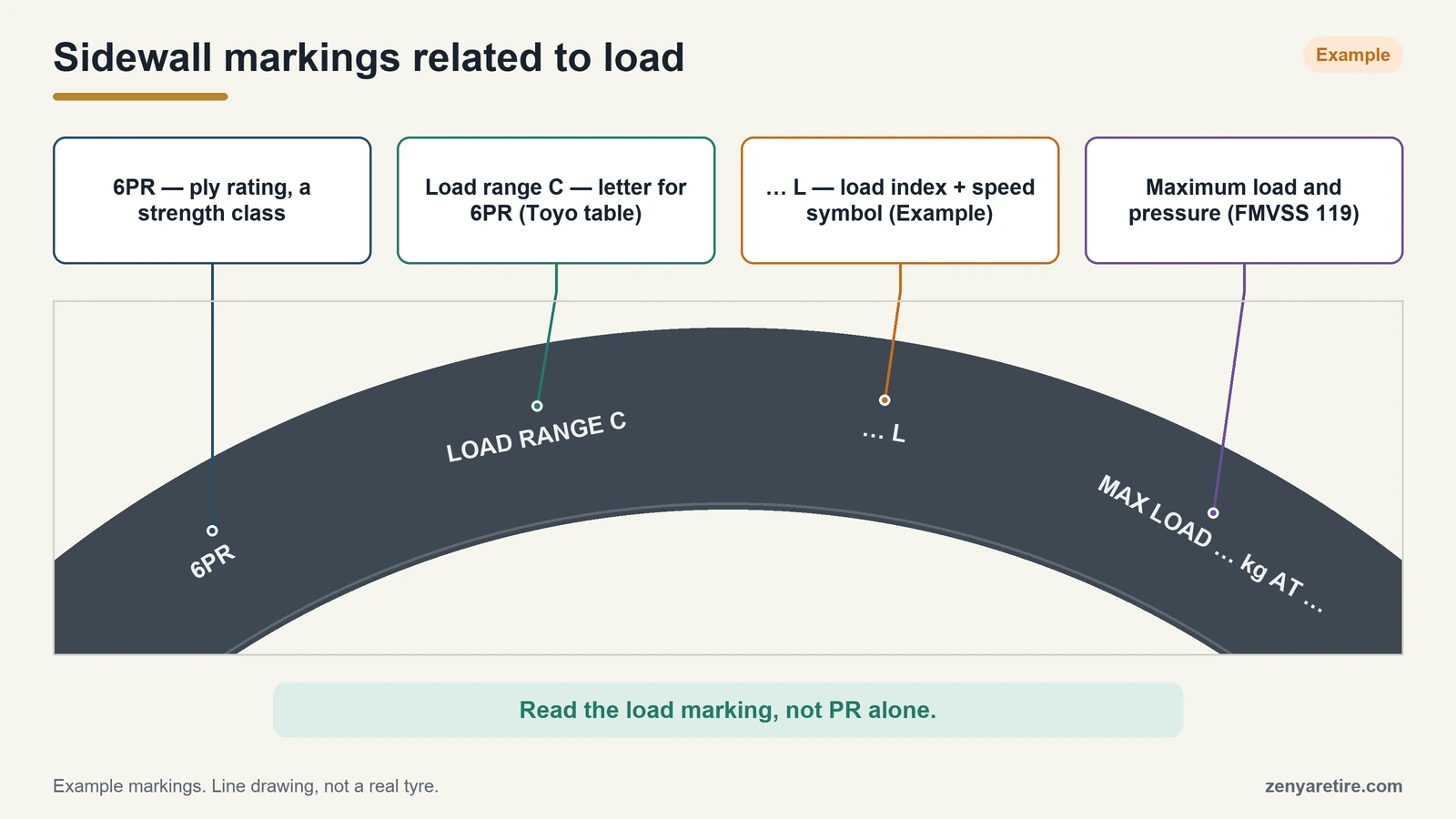
A ply rating (PR) such as 4PR, 6PR or 8PR is a strength rating for a tyre, not a count of the layers inside it. A 6PR tyre does not necessarily have six plies. To judge what a tyre can carry, read the load marking on the sidewall (a load index, or a maximum load at a stated pressure) and check it against the size and load limit in the motorcycle owner's manual. PR on its own is not enough.
This guide explains where PR comes from, how it relates to load index and sidewall load marks, and what to put in an inquiry when your customers ride loaded bikes.
What does "PR" mean on a motorcycle tyre?
PR stands for ply rating. Toyo Tires defines it this way: ply rating "is used to identify a given tire with its maximum recommended load when used in a specific type of service. It is an index of tire strength and does not necessarily represent the number of cord plies in the tire."
So "6PR" tells you which strength class the tyre belongs to. It does not tell you that six cord layers were built into the casing.
Motorcycle tyre maker Mitas describes PR in the same spirit. In its list of sidewall markings, it says PR "designates various tyre versions (load index/inflation pressure) of the same dimension designation." In other words, one size can come in more than one PR version, and the versions differ in the load and pressure they are rated for.
Is a 6PR tyre built with six plies?
Not necessarily. The number on the tyre is a rating, not a layer count: Toyo says ply rating "does not necessarily represent the number of cord plies in the tire."
US rules make the difference visible. The US tyre standard FMVSS 119 (49 CFR 571.119) covers, among others, "tires for motorcycles". It requires the sidewall to show, as separate items:
| Item required by FMVSS 119, S6.5 | What it tells you |
|---|---|
| (d) Maximum load rating and corresponding inflation pressure | How much the tyre may carry, and at what cold pressure |
| (f) Actual number of plies and the ply cord material, in the sidewall and tread area | What the casing is really built from |
| (j) Letter designating the tyre load range | The load class |
Because "actual number of plies" is its own line, a US-market tyre can carry a load range letter or rating and, separately, a statement such as the real number of plies and cord material. Read both rather than assuming they match.
How does ply rating relate to load range and load index?
They describe related things in different ways:
- Ply rating (PR): a strength class written as a number (4PR, 6PR, 8PR).
- Load range: a letter that corresponds to a ply rating. Toyo calls it "merely a letter used to correspond with a ply rating" and lists 4PR as B, 6PR as C and 8PR as D.
- Load index (LI): a number in the service description after the size (the number just before the speed symbol in the service description after the size), which stands for a maximum load in the tyre maker's load index table.
- Maximum load and pressure: some sidewalls state the load in kilograms or pounds at a stated cold pressure. Dunlop notes that "maximum loads and the corresponding pressures are indicated on the sidewall of all Dunlop street tires."
Mitas also lists "REINF" (reinforced) as a marking for "motorcycle tyres for load and inflation pressures that exceed standard values." A REINF tyre is read the same way: by its load marking.
The practical point: compare load markings, not PR alone. Mitas ties the PR versions of one size to their load index and inflation pressure, so the load marking is what you check against the bike.
Does a higher PR mean the bike can carry more?
No. A higher-rated tyre does not raise the bike's load limit. Dunlop is direct about this: "It is possible to overload a tire even though it is the size specified by the motorcycle manufacturer," and the total weight of luggage, equipment and riders "must never exceed the vehicle load capacity found in the motorcycle owner's manual."
Dunlop also notes that the load a tyre can carry "is also reduced by underinflation." A tyre rated for a load at a stated pressure only carries that load at that pressure.
For a distributor, this changes how you talk about PR:
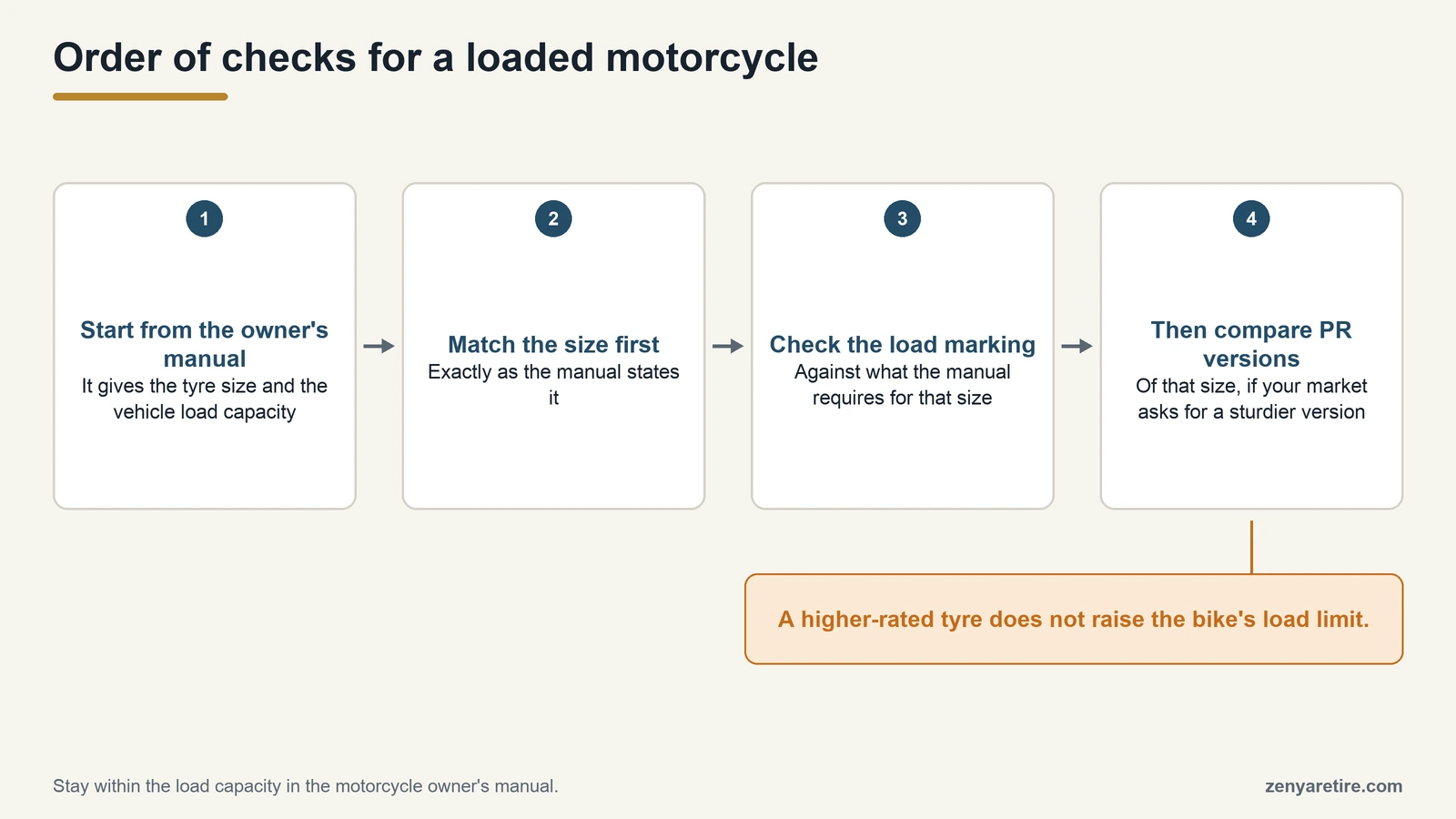
- Start from the owner's manual. It gives the tyre size and the vehicle load capacity.
- Match the size first, exactly as the manual states it.
- Check the load marking on the tyre you plan to stock against what the manual requires for that size.
- Then compare PR versions of that size if your market asks for a sturdier version, for example for bikes that run with a passenger or cargo every day.
Do not sell a higher PR as a way to carry more than the bike is rated for.
What should I put in an inquiry for loaded bikes?
Write the full marking you need, not just "6PR". For each line, send:
- Size, as the owner's manual gives it (for example 2.75-17 or 3.00-18).
- PR or load marking your market expects, and whether you need the load index or the maximum load figure.
- TT or TL.
- Pattern (ZY-001 to ZY-212 in our catalogue) or the use (cargo, taxi, commuting).
- Quantity per size and pattern, at least 300 pieces.
Example inquiry
Example (invented for illustration; the sizes and ratings are not taken from our price list):
3.50-18, 6PR, TT, cargo pattern, 600 pcs. Please state the load index and the maximum load and pressure marked on the sidewall for this version. Price ex-factory.
We confirm the pattern and TT or TL version for each size in the quotation.
FAQ
Is 8PR stronger than 6PR?
An 8PR tyre is rated for a higher strength class than a 6PR tyre in the same type of service. Check the load marking on each, and stay within the motorcycle's own load capacity.
Does PR tell me how many layers are inside the tyre?
Not necessarily. Toyo describes ply rating as "an index of tire strength" that "does not necessarily represent the number of cord plies." US-market tyres show the actual number of plies as a separate sidewall item under FMVSS 119.
Can I replace a tyre with a higher PR version?
Fit the size given in the owner's manual first. A higher-rated version of the same size can be chosen, but it does not raise the bike's load limit.
Do you list PR for every size?
Not on our website. Ask us per size.
Ask for the markings you need
See our motorcycle tyres, our guide to the parts of a motorcycle tyre, and how to read a line in our tyre catalogue. To ask about a size, contact us. We usually reply within one working day (GMT+8).
Sources
| Source | What it supports | Checked |
|---|---|---|
| Toyo Tires — Tire Size and Dimension Definitions (PDF) | Ply rating is a strength index, not necessarily the ply count; load range letters by PR | 2026-11-24 |
| Mitas — Instructions and tips for motorcycle users | PR and REINF markings on motorcycle tyres | 2026-11-24 |
| eCFR — 49 CFR 571.119 (FMVSS 119) | US sidewall markings: maximum load and pressure, actual number of plies, load range | 2026-11-24 |
| Dunlop Motorcycle Tires — Tire care | Overloading, underinflation and the owner's manual load capacity | 2026-11-24 |
| ZENYARE — Motorcycle tyres | TT/TL, patterns, what we confirm in the quotation | 2026-11-24 |