
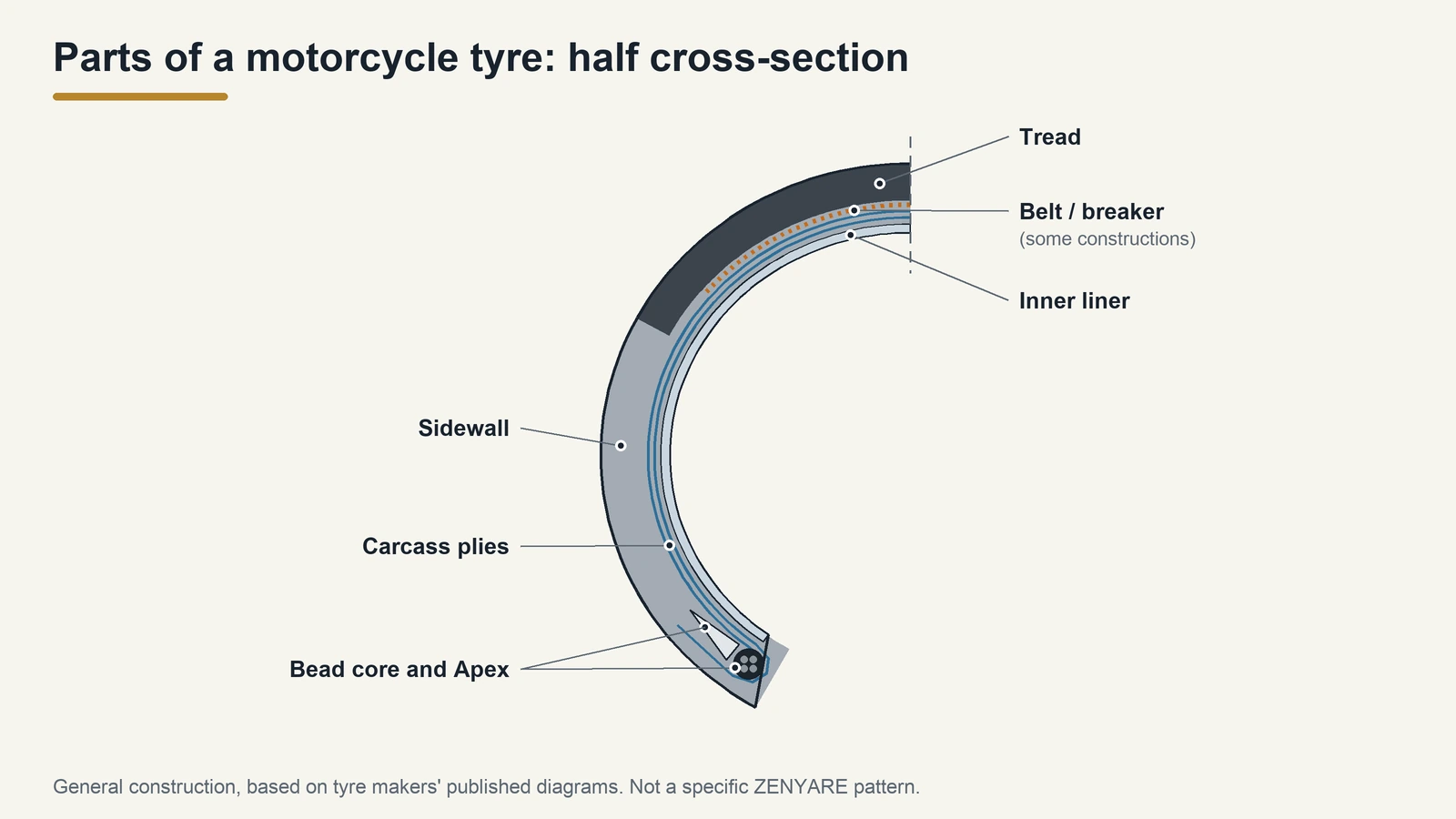
A motorcycle tyre is built from six main parts: the bead, which holds the tyre on the rim; the carcass, made of fabric plies that carry the load; on some constructions, a belt or breaker under the tread; the inner liner; the sidewall; and the tread that touches the road. How the carcass plies are laid, and whether there is a belt, decides whether a tyre is bias (crossply), bias-belted or radial. The sidewall marking tells you which one you are holding.
This guide explains each part with the definitions tyre makers publish, so you can read a construction diagram or a catalogue line with confidence. It is general background. It does not describe the construction of any particular ZENYARE pattern.
What are the main parts of a motorcycle tyre?
Continental lists the components of each motorcycle tyre construction on its tyre-knowledge page, and Michelin's glossary defines the main parts. These are the parts most constructions share:
| Part | What it is | Definition source |
|---|---|---|
| Bead (bead core) | The part that sits on the wheel; inside is a hoop of steel wires that clamps the tyre against the rim | Michelin glossary |
| Apex | A rubber filler above the bead core | Continental parts list |
| Carcass (casing) | The supporting structure: plies anchored to the bead on one side, running to the bead on the other | Michelin glossary |
| Ply | A rubber-coated fabric layer with parallel cords; plies run from bead to bead | Michelin glossary |
| Inner liner | The innermost layer; on a tubeless tyre it is made with a nearly airtight butyl compound | Michelin glossary |
| Sidewall | The part between the tread and the bead; it carries the sidewall markings | Michelin glossary |
| Tread | The part that contacts the road, with its pattern of grooves | Michelin glossary |
Two more parts appear only in some constructions: a breaker or a belt under the tread. They are covered below.
What does the bead do?
The bead is what keeps the tyre on the wheel. Michelin's glossary describes it as "the section of the tire that sits on the wheel", with "a round hoop of steel wires, wrapped or reinforced by body ply cords, that clamps the tire firmly against the wheel rim."
For a buyer, the practical point is simple: the bead seat must match the rim diameter in the size, for example the "18" in 3.00-18. A tyre for one rim diameter does not fit another.
What is the carcass, and what are plies?
The carcass, also called the casing, is the tyre's skeleton. Michelin defines it as "the supporting structure of the tire consisting of plies anchored to the bead". Each ply is a rubber-coated fabric layer with parallel cords.
Continental's parts lists name the carcass materials it uses: rayon or polyamide in its crossply, breaker and bias-belted tyres, and polyamide in its radial tyres. These are Continental's examples, not a rule for every maker.
The angle of the cords in the plies is what separates the constructions.
What is the difference between bias, bias-belted and radial tyres?
| Construction | How the carcass is laid | Extra layer under the tread | Sidewall marking | Source |
|---|---|---|---|---|
| Bias (crossply) | Plies run diagonally to the centre line and cross each other | None | A dash, as in 4.00 - 18 | Continental; Michelin |
| Breaker | Crossply carcass | A breaker that reinforces the tread area | A dash, as in 130/90 - 16 | Continental |
| Bias-belted | Crossply carcass | A belt, "usually made from Kevlar" | B, as in 150/70 B 17 | Continental |
| Radial | Cords at about 90° to the direction of travel | A belt at 0° | R, as in 190/50 Z R 17 | Continental; Michelin |
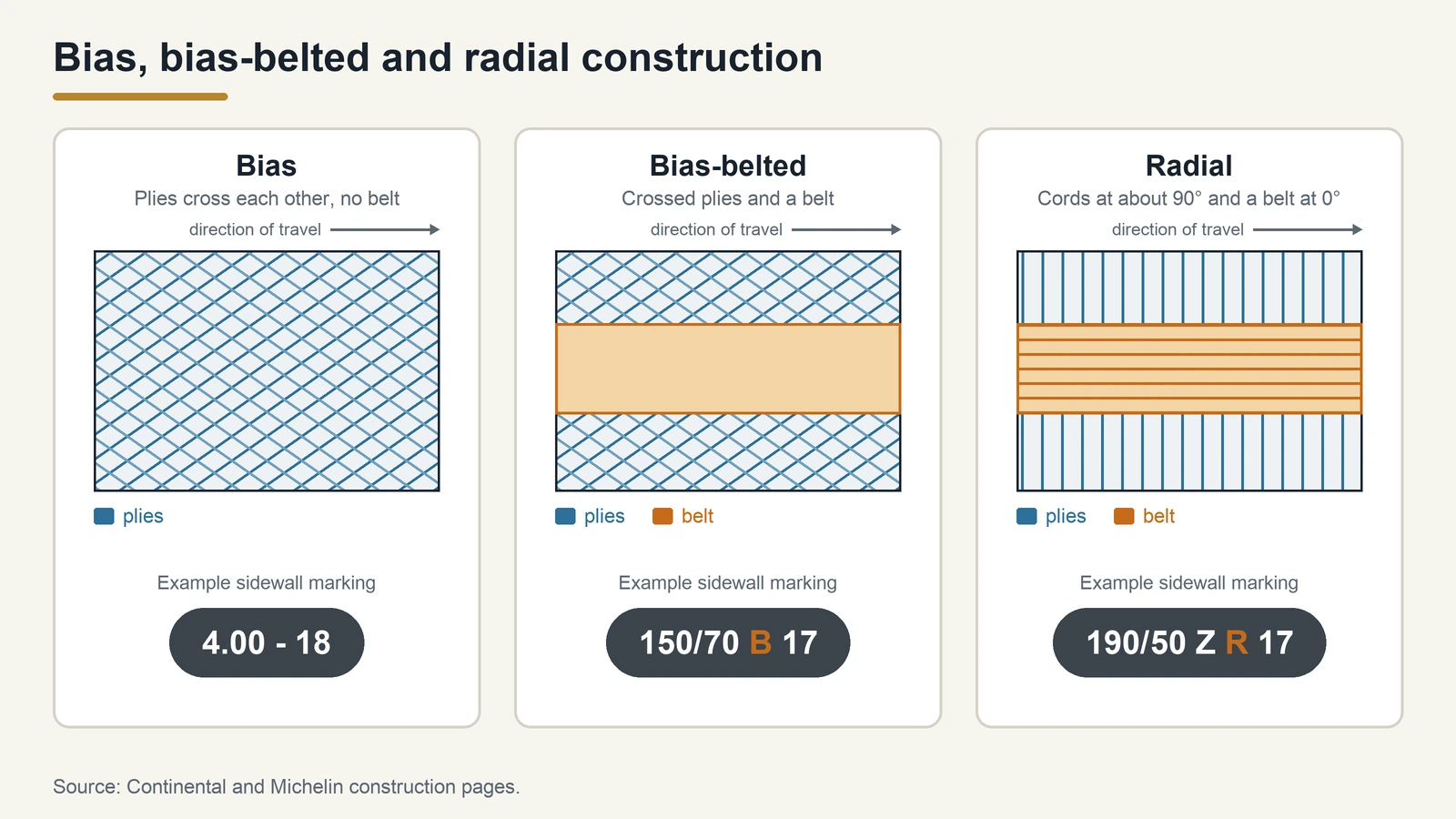
Michelin explains the effect. In a bias tyre "the crown and sidewalls of the tire have similar mechanical properties." In a radial tyre "the crown and sidewalls have their own particular characteristics": the crown is stiffened by the belt, while the sidewall stays more flexible.
Continental adds a speed comparison from its own range: its crossply tyres have "a maximum design speed of 240 km/h (150 mph)", and a 4.00 - 18 M/C 64H TT tyre "grows" by approximately 2 cm on average at 210 km/h, while a comparable radial tyre expands by only a few millimetres.
Which construction is used for which bikes?
Construction follows use. Michelin says bias ranges are still offered for "Cross, Custom and Scooter tyres", because that structure suits those uses. Michelin adds that radials "are now widely used for road, sport and long-distance trail riding".
What matters for an order is the bike, not the trend. Michelin's advice is direct: "The owner's manual specifies which construction type is required", and "Never mix radial and bias construction on the same motorcycle."
How can I tell the construction from the sidewall?
Read the size line:
- A dash between the aspect ratio and the rim diameter, as in 4.00 - 18 or 130/90 - 16. Continental's crossply and breaker examples are written this way.
- A B in the same position, as in 150/70 B 17, marks a bias-belted tyre.
- An R or ZR, as in 190/50 Z R 17, marks a radial tyre.
- M/C means the size is for a motorcycle.
- TT or TL tells you whether the tyre is tube-type or tubeless. On a TL tyre, Michelin describes the inner liner as the layer made with "virtually impermeable butyl rubber".
If you sell into a market that checks approvals, read the size line together with the approval marks. Our guide to reading a tyre catalogue line shows how size, pattern and TT/TL appear in a quotation.
What should a buyer ask about construction?
Structure names tell you how a tyre is built, not how a particular pattern performs. Before you order, ask for these per size and pattern:
- Construction (bias, bias-belted or radial), as marked on the sidewall.
- Tube-type or tubeless.
- Load index and speed symbol.
- The ply rating, if your market uses it.
Ask us to confirm these for each size and pattern before you order, rather than inferring them from a diagram.
FAQ
What is the carcass of a motorcycle tyre?
It is the tyre's supporting structure: fabric plies anchored to the bead on each side. Michelin also calls it the casing.
What does the B mean on a motorcycle tyre?
B marks a bias-belted tyre: a crossply carcass with a belt under the tread. Continental gives 150/70 B 17 as an example.
Can I fit a radial front with a bias rear?
Michelin advises against it: "Never mix radial and bias construction on the same motorcycle." Follow the owner's manual.
Do all tyres have a belt?
No. In Continental's descriptions, crossply tyres have no belt, breaker tyres have a breaker, and bias-belted and radial tyres have a belt.
Need a quote by size and pattern?
ZENYARE is the brand of Qingdao Zhengya Rubber Industrial Co., Ltd., founded in 2011. We make motorcycle tyres, tube-type and tubeless, in 200+ patterns (ZY-001 to ZY-212). MOQ: 300 pieces per size and pattern. Several sizes can share one container, with each size still at its MOQ. See our motorcycle tyres, read about us, or send your size list.
Sources
| Source | URL | Checked |
|---|---|---|
| Continental, motorcycle tire construction: crossply, breaker, bias-belted and radial parts lists; B and R markings; crossply design speed; tyre growth at 210 km/h | https://www.continental-tires.com/tire-knowledge/tire-construction/ | 2026-11-15 |
| Michelin USA, "Radial vs Bias-Diagonal Tires": ply angles, crown and sidewall behaviour, "Never mix radial and bias construction" | https://www.michelinman.com/motorcycle/tips-and-advice/how-to-choose-the-right-motorcycle-tire/radial-or-bias | 2026-11-15 |
| Michelin glossary: bead, casing, ply, inner liner, sidewall, tread | https://middle-east.michelin.com/en/auto/assistance/glossary | 2026-11-15 |
| Michelin UK, "The evolution of motorcycle tyres": bias ranges for cross, custom and scooter tyres; radials for road, sport and trail | https://www.michelin.co.uk/motorbike/advice-motorbike/tyre-basics/evolution-motorcycle-tyres | 2026-11-15 |
| Michelin UK, "How to read the motorcycle tyre size": "M/C : This code simply means that it is a tyre for motorcycles." | https://www.michelin.co.uk/motorbike/advice-motorbike/tyre-basics/motorcycle-tyre-size | 2026-11-15 |