
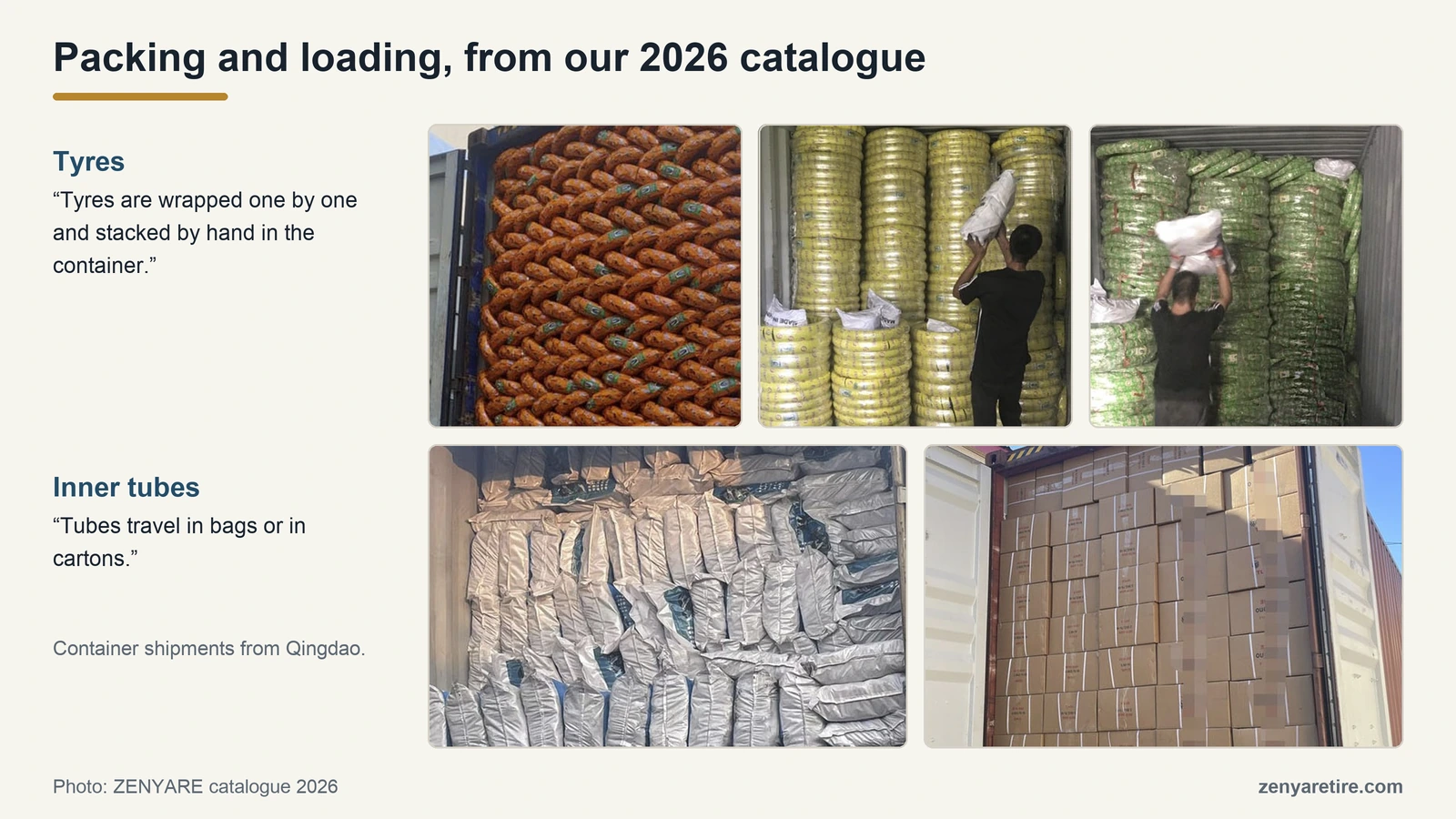
Our motorcycle tyres are wrapped one by one and stacked by hand in the container. Inner tubes travel in bags or in cartons. Shipments go by container from Qingdao. That is how our 2026 catalogue describes packing and loading, and we confirm the packing and container loading for each order in the quotation.
This page explains what that means for a first full-container order, which details to agree before loading, and what the international code of practice for packing containers says about loads like this.
How are ZENYARE motorcycle tyres packed?
Each tyre is wrapped individually and then stacked by hand inside the container. Our catalogue puts it in one line: "Tyres are wrapped one by one and stacked by hand in the container."
Two things follow from that:
- Tyres are stacked by hand in the container. That is how our catalogue describes loading.
- Packing is confirmed per order. Our tyre product page says we confirm "pattern, TT or TL version, packing and container loading in the quotation."
The catalogue doesn't specify the wrapping material. If your market or your warehouse needs a particular wrapping, label or marking, say so when you ask for a quotation.
How are inner tubes packed?
Inner tubes are packed in bags or in cartons. The catalogue says: "Tubes travel in bags or in cartons." Our inner tube page adds that for custom marking or packing, you can ask us and we check with the factory.
Bags or cartons is confirmed in the quotation. For custom marking or packing, ask us and we check with the factory.
Can I mix several sizes in one container?
Yes. Several sizes can share one container. The minimum order still applies to each size:
| Product | Minimum order |
|---|---|
| Motorcycle tyres | 300 pieces per size and pattern |
| Motorcycle inner tubes | 2,000 pieces per size and material (natural rubber or butyl) |
Lead time is 20–30 days. Payment is 30% deposit, balance before shipment.
What does the CTU Code say about packing a container?
The CTU Code is the IMO/ILO/UNECE Code of Practice for Packing of Cargo Transport Units, published by the International Maritime Organization in 2014 as circular MSC.1/Circ.1497. The IMO describes it as "a non-mandatory global code of practice." It doesn't name tyres, so the points below are its general rules for packages, not tyre-specific requirements.
Weight and balance
The Code's key requirements for packing include:
- "Do distribute heavy cargo appropriately over the floor area."
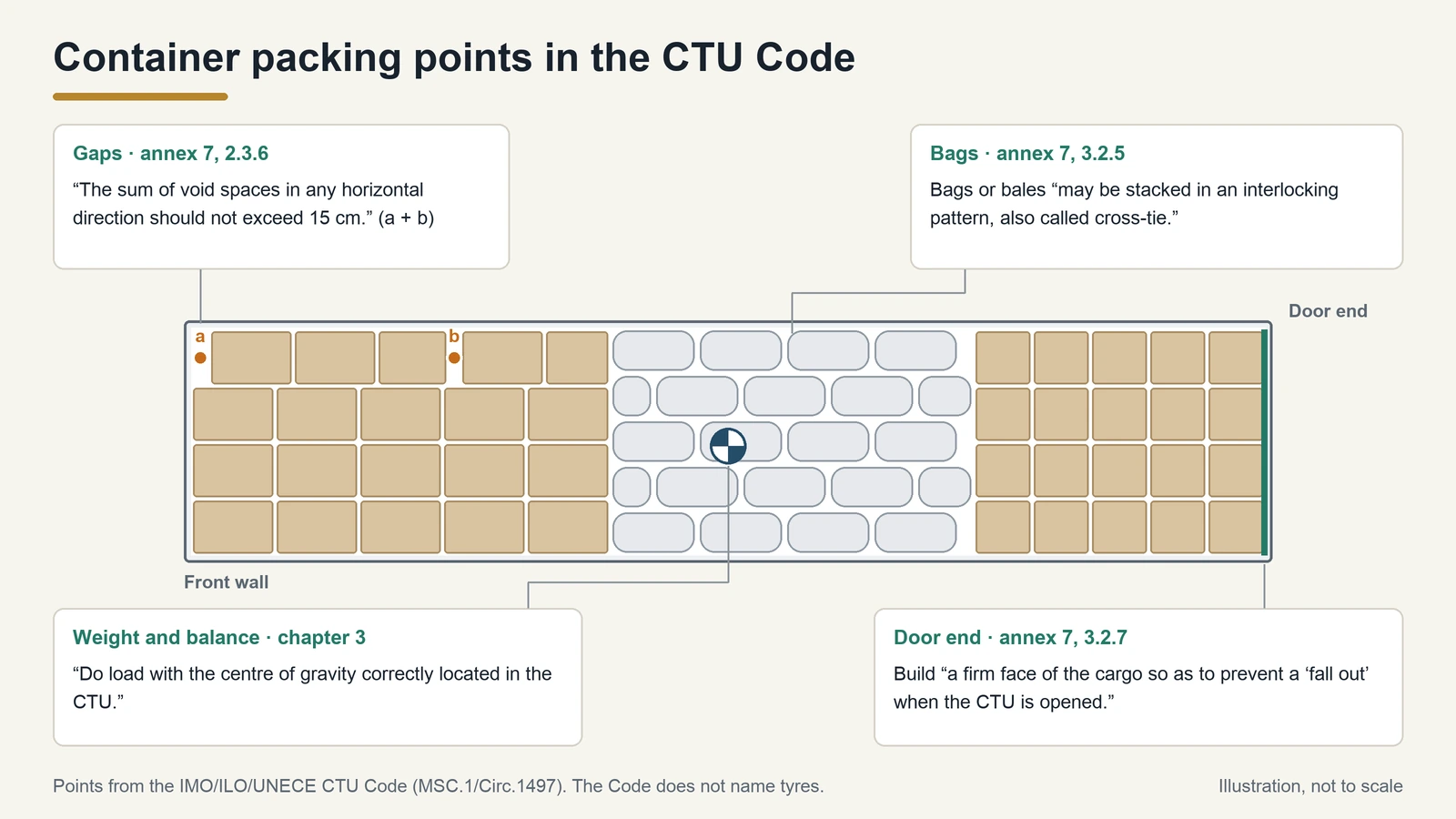
- "Do load with the centre of gravity correctly located in the CTU."
- "Do not stow heavy goods on top of light goods."
- "Do not exceed the permitted payload limits of the unit…"
Annex 7 adds that "the mass of the planned cargo should not exceed the maximum payload of the CTU." For freight containers, the permitted maximum gross mass is marked on the CSC safety approval plate.
Stacking and gaps
The Code says planning should aim at either a tight stow, with "all cargo packages … placed tightly within the boundaries of the side and front walls," or a secured stow, where packages are held by blocking or lashing.
In a form-locked stow, the Code says void spaces should be filled, and "the sum of void spaces in any horizontal direction should not exceed 15 cm." It also warns against irregular layers: "Do not build up irregular layers of packages if it can be avoided."
For "packages with a less defined shape like bags or bales," the Code says they "may be stacked in an interlocking pattern, also called cross-tie."
The door end
Near the end of packing, the Code says "care should be taken to build a firm face of the cargo so as to prevent a 'fall out' when the CTU is opened." This matters to whoever opens the container at your warehouse.
Moisture
The Code lists "moisture introduced by packing the CTU during rain or snow" as one source of humidity in a container, and says "Do not pack wet and damp goods if it can be avoided." Its annex 3 covers preventing condensation damage.
What should I agree with the supplier before loading?
Use this list when you confirm your first order:
- Sizes, patterns and quantities, each meeting the minimum order.
- TT or TL version for each tyre size.
- Tube material and packing: natural rubber or butyl; bags or cartons.
- Marks: what goes on bags, cartons or labels, if anything.
- Mixed loading: which sizes share the container.
- Loading information you want after loading, such as a packing list.
For the packing list itself, agree the format with your forwarder or customs broker.
FAQ
How are motorcycle tyres packed in a shipping container?
Ours are wrapped one by one and stacked by hand in the container, as our catalogue says. Packing and container loading are confirmed for each order in the quotation.
Are tyres put on pallets?
Our catalogue says tyres are stacked by hand in the container. If you need a different method, ask when you request a quotation.
How are inner tubes packed?
In bags or in cartons, confirmed in the quotation. For custom marking, ask us and we check with the factory.
Is there an international standard for packing containers?
The IMO/ILO/UNECE CTU Code (MSC.1/Circ.1497) is the international code of practice. The IMO describes it as non-mandatory, and it doesn't name tyres.
Can I mix several sizes in one container?
Yes. Each size still needs its minimum order: 300 pieces per size and pattern for tyres, 2,000 pieces per size and material for tubes.
Send us your sizes and packing needs
Send your tyre and tube sizes, quantities and any packing or marking requirements. We confirm pattern, TT or TL version, packing and container loading in the quotation. See our motorcycle tyres and motorcycle inner tubes, or contact us. We usually reply within one working day (GMT+8).
Sources
| Source | What it supports | Checked |
|---|---|---|
| ZENYARE Motorcycle Tyre Catalogue 2026, "Packing and loading" | Tyres wrapped one by one and stacked by hand; tubes in bags or cartons; container shipments from Qingdao | 2026-11-19 |
| IMO — CTU Code | Non-mandatory code of practice; 2014; IMO/ILO/UNECE | 2026-11-19 |
| IMO/ILO/UNECE Code of Practice for Packing of Cargo Transport Units, MSC.1/Circ.1497 (PDF) | Key requirements (chapter 3); annex 7 sections 1.2, 1.8, 2.3.6, 3.2.5, 3.2.7; moisture and condensation | 2026-11-19 |